

Start with what the firm actually wants
The first conversation was not about keywords. It was about cases. The firm wanted more landlord-tenant work: evictions for landlords, and habitability, rent control and wrongful eviction cases for tenants. Personal injury was real business, but it was not the focus.
The old site said all of it at once. When a page tries to rank for everything, it usually ranks for nothing. So the first decision was simple. Landlord-tenant became the spine of the site, and everything else became secondary.
Move off Squarespace without losing anything
I moved the site to a fast custom static build on Netlify. Before I touched a single page, I listed every URL Google already had indexed. Every one of them either kept its address or got a proper redirect. A redesign that breaks old URLs throws away whatever ranking the firm already earned, and I was not going to do that.
Static pages load fast on a phone, they do not break when a plugin updates, and they give me full control over titles, schema and the sitemap.
Four practice pages at the top
Each landlord-tenant practice area got its own real page: evictions and unlawful detainer, habitability, rent control violations and wrongful eviction. Each one explains the law in plain English, who the firm helps, and what happens next. These four pages are the top of the whole structure.
39 cities, each with its own front door
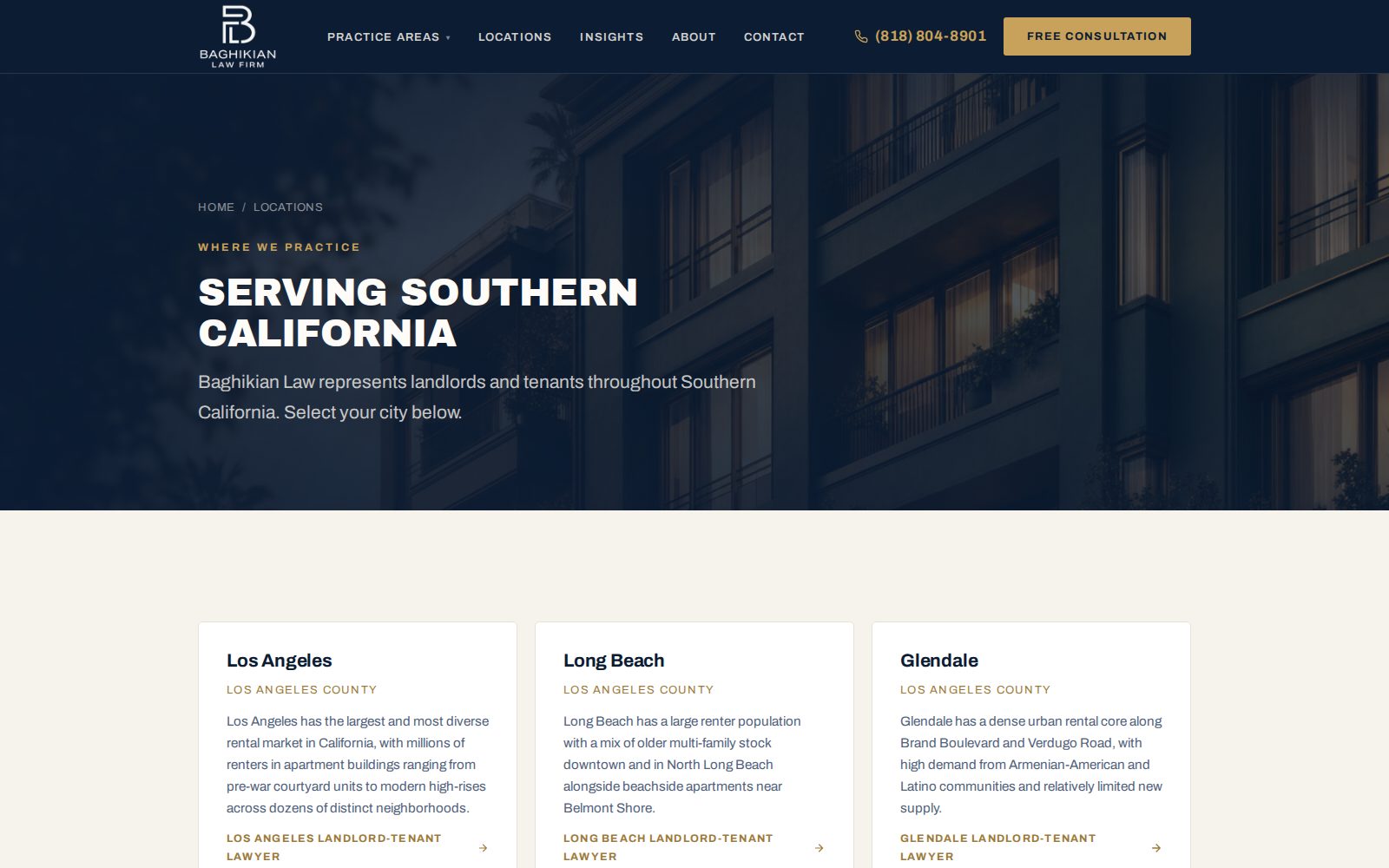
Next came a hub page for every city the firm serves. That is 39 cities, from Los Angeles, Long Beach and Pasadena to Pacoima, Cudahy, Maywood and Bell Gardens. Each hub describes the local rental market in a sentence or two. Glendale, for example, has a dense rental core along Brand Boulevard and limited new supply.
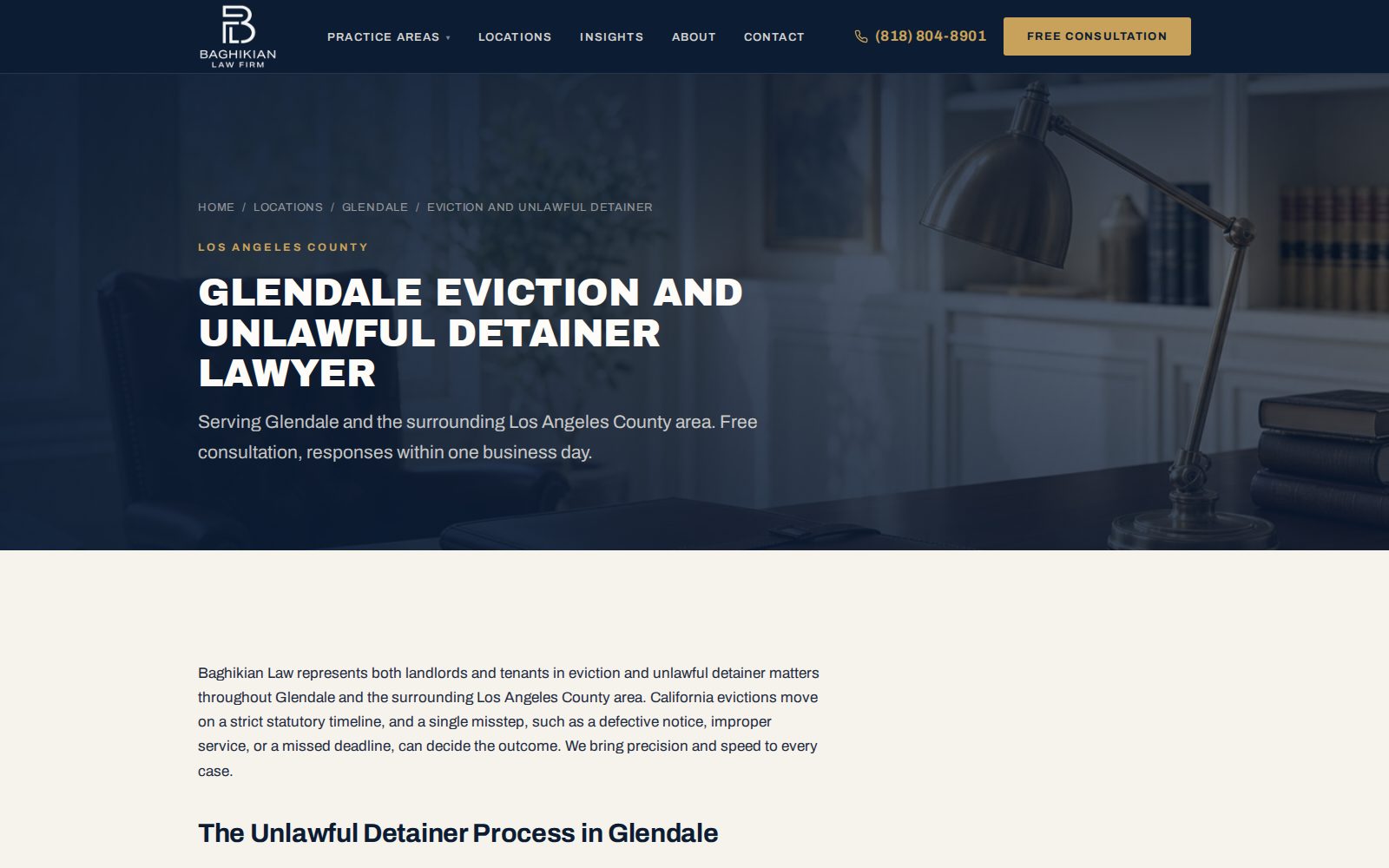
Under every hub sit four pages, one for each practice area in that city. 39 cities times 4 practice areas is 156 city practice pages. Each runs about 500 to 600 words.
Why these city pages are not spam
This is the part most agencies get wrong. They write one paragraph and swap in a new city name 150 times. Google figures that out, and the person reading figures it out faster.
Every Baghikian city page says which rent rules apply in that specific city. The Compton rent control page explains that Compton has no local rent control ordinance, so covered units fall under AB 1482, the statewide Tenant Protection Act. Then it names the neighborhoods the firm serves there. Someone in Compton gets an answer for Compton. That is a reason for Google to show the page, and a reason for the reader to call.
Articles that answer real questions
Then I wrote what renters and landlords actually type into Google. 26 plain-English articles and about 10 long legal guides. Can a landlord enter without notice. How much can rent go up in California. How long an eviction stays on your record. Cash for keys. Squatters. Security deposits under the new AB 12 cap.
Each article links back to the practice page and city pages it supports. That is how the authority from helpful content flows into the pages that bring in cases. These are also the kinds of pages AI answers like ChatGPT and Google's AI Overviews pull from, because they answer a question clearly and directly.
The technical layer
Every page got a unique title and H1, legal service schema, FAQ schema where there are questions, breadcrumbs and a canonical tag. The full 258-URL sitemap went into Search Console. Nothing fancy. It just has to be right on every single page, and on a site this size, that is where most of the work hides.
Ads split by who is searching
A landlord with a tenant who stopped paying and a tenant with a landlord who will not fix the heat are two different people. So I split Google Ads into a landlord campaign and a tenant campaign. Each has its own landing page, and each uses the other's keywords as negatives so they do not compete with each other.
What happened
The firm went from a single Squarespace page to 258 indexed pages, and it now ranks #1 on Google for landlord-tenant attorney searches. Personal injury, dog bite and rideshare pages still exist, so that work still gets found. But the message is clear now, to Google and to clients: this is a landlord-tenant firm.
If your law firm has one page trying to cover everything you do, this is the playbook. It is the same one I use for every law firm I take on. You can see the full Baghikian Law case study or how I work with law firms.
Common questions
How many city pages should a law firm have?
One for every city you actually serve and can write something specific about. Baghikian has 39 because the firm takes cases across all of them, and each city page says something true about that city's rent rules.
Will moving off Squarespace hurt my rankings?
Not if every indexed URL keeps its address or gets a proper redirect. I list every URL Google has before I change anything.
How long does a build like this take?
The structure and core pages come first, then cities and articles roll out in phases. I talk timelines on the first call once I see your current site.
What does it cost?
Plans start at $1,500 a month for SEO, AEO/GEO, site cleanup and Google Business Profile. Growth is $2,500 a month and adds Google and Meta ads. Full-service is $5,000 a month and adds a full website rebuild like this one. Month to month.